

Overview
Humanos brings human authorization into automated workflows. Digital systems like APIs, workflows, and autonomous agents can verify in real time whether a human has approved an action. If an authorization is missing, Humanos can request it immediately through a secure, unified flow, so processes never stall on compliance or pending approvals. By turning human decisions into programmable, verifiable events, organizations automate more confidently, reduce operational friction, and maintain full traceability of every authorization in a business process.Base URL:
https://api.humanos.tech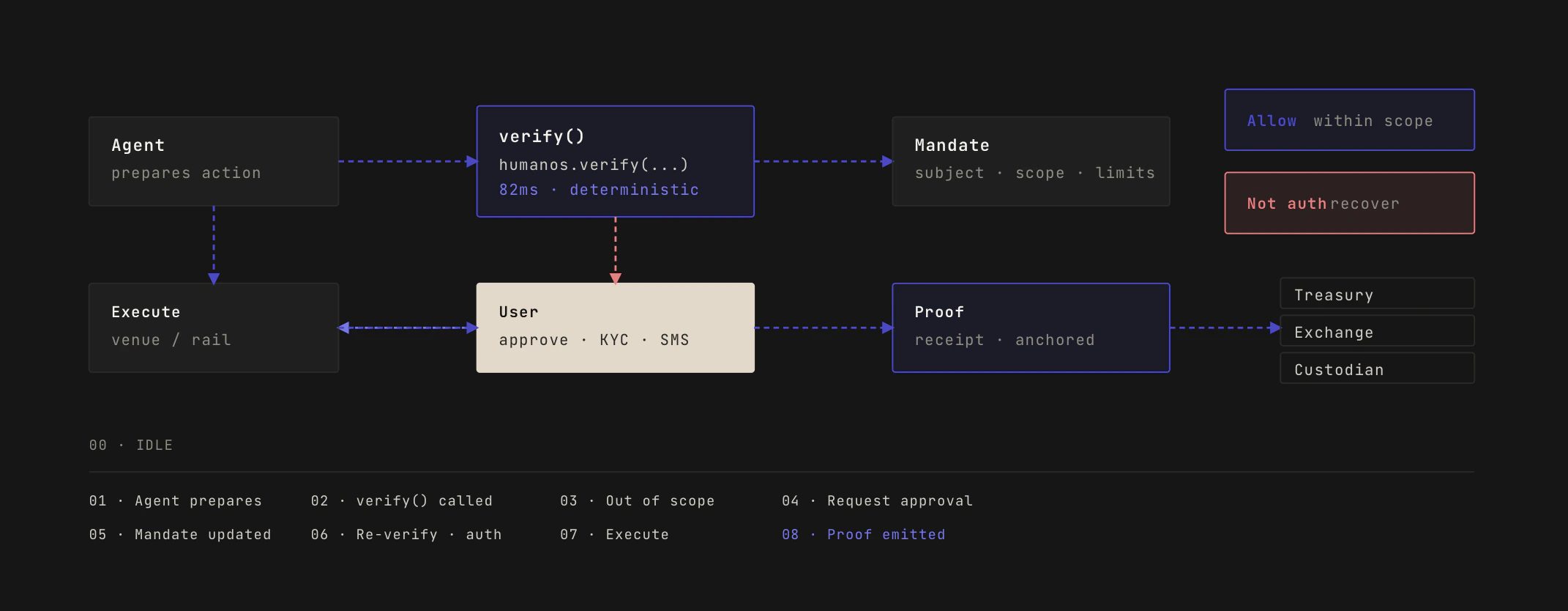
SDKs
Skip the raw HTTP calls. Our official SDKs wrap every endpoint in idiomatic bindings for your stack, including auto-signing and webhook decryption.- TypeScript
- Python
- C#
For the full SDK documentation click here.
Concepts
Lifecycle
A mandate’s lifetime breaks into two flows:- Request and approval happens once. You define an action, request a mandate, and the user accepts or rejects. On accept, Humanos issues the mandate and you persist its ID.
- Issuance and verification happens on every action. The agent issues a fresh VP from the mandate, Humanos verifies it against the agent’s
executionParams, and returns allow or deny.
Audit trail
Every consequential event in a mandate’s lifecycle, whether issuance, approval, verification, or revocation, is persisted as an immutable, cryptographically signed record that you can query through the activity API. You get a complete, tamper-evident history without logging anything yourself.W3C standards
Every entity in the Humanos ecosystem, whether an automated system, an organization, or an end user, is identified by a Decentralized Identifier, or DID, that complies with the W3C DID standard. All authorizations are encapsulated as W3C Verifiable Credentials 2.0, giving each authorization a cryptographic proof, a tamper-evident structure, and a complete audit trail.DID 1.1
W3C standard for verifiable identities with no central registry.
VC 2.0
W3C data model for the credentials every authorization uses.